
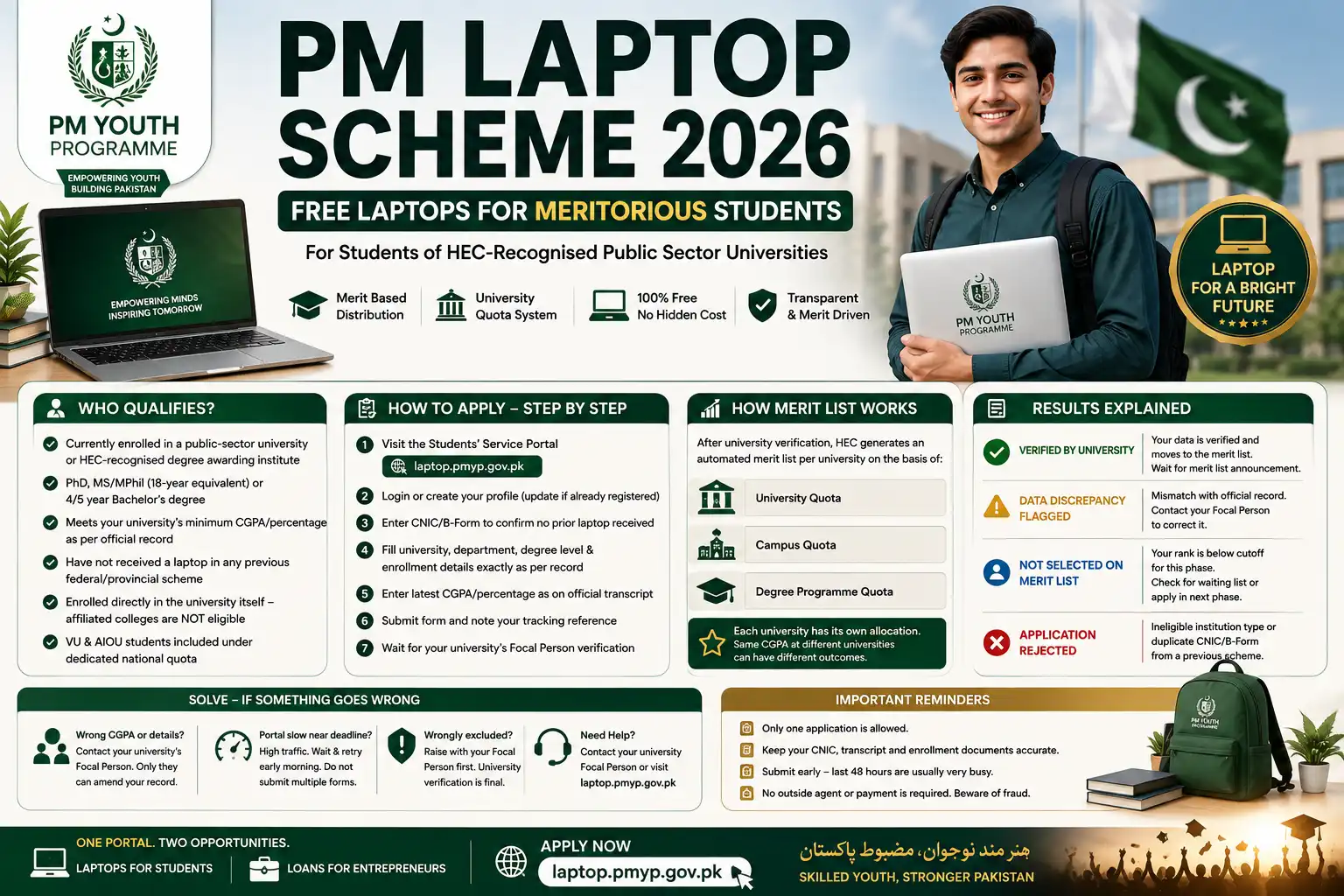
The PM Laptop Scheme, part of the PM Youth Programme, gives free laptops to eligible students at HEC-recognised public-sector universities, distributed by university quota and academic merit. Phase VI opened in 2026, run entirely through the Students’ Service Portal at laptop.pmyp.gov.pk, with no other application channel accepted by HEC. Only students currently enrolled in a public-sector university or degree-awarding institute qualify — affiliated colleges of those universities do not. This guide covers who’s eligible, how to apply, and what to do if your application is rejected.
Who Qualifies
Eligibility is verified by your own university’s Focal Person against your official academic record, according to laptop.pmyp.gov.pk. You generally need to be:
| Requirement | Detail |
|---|---|
| Enrollment | Currently enrolled in a public-sector university or HEC-recognised Degree Awarding Institute — main or officially recognised sub-campus |
| Programme | PhD, MS/MPhil (18-year equivalent), or a 4- or 5-year Bachelor’s degree |
| Academic standing | Meets your university’s minimum CGPA or percentage cutoff, confirmed on your own laptop.pmyp.gov.pk dashboard rather than a single fixed number site-wide |
| Prior laptop history | Have not already received a laptop under any previous federal or provincial scheme |
| Institution type | Enrolled directly in the university itself — affiliated colleges of public universities are not eligible |
You can only apply from the university where you’re currently enrolled, and Virtual University and AIOU students are generally covered under a dedicated national quota rather than being excluded.
How to Apply — Step by Step
- Go to the Students’ Service Portal at laptop.pmyp.gov.pk.
- If you registered in an earlier phase, log in and update your existing profile instead of creating a new one.
- Enter your CNIC or B-Form number to confirm you haven’t received a laptop in a previous phase.
- Fill in your university, department, degree level, and current enrollment details exactly as your institution has them on record.
- Enter your latest CGPA or percentage precisely as shown on your official transcript.
- Submit the form and note your tracking reference.
- Wait for your university’s Focal Person to verify your data — this is the step that actually decides whether your application moves forward, not the initial submission.
How the Merit List Works
Once your university’s Focal Person verifies your record, HEC runs an automated process to generate a merit list per university, based on a predefined quota — university quota, campus quota, and degree-programme quota all factor in, according to laptop.pmyp.gov.pk. This means two students with the same CGPA at different universities can get different outcomes, because each university is working within its own laptop allocation, not one national ranking.
Results Explained
| Status shown | What it means | What to do |
|---|---|---|
| Verified by university | Your data has passed your Focal Person’s check and moves into the merit-list run | Wait for your university’s or HEC’s merit-list announcement |
| Data discrepancy flagged | A mismatch was found between your submitted data and your official university record | Contact your Focal Person to correct it — you generally can’t fix this yourself once flagged |
| Not selected on merit list | Your quota-adjusted rank fell below the cutoff for your university this phase | Check for a waiting list, and consider reapplying if a future phase opens |
| Application rejected outright | Usually an ineligible institution type or a duplicate CNIC/B-Form from a prior laptop | Confirm your enrollment type with your university; a prior recipient can’t reapply |
Solve — If Something Goes Wrong
If your CGPA or enrollment details show incorrectly on the portal, the fix goes through your university’s Focal Person, not HEC directly — they’re the only account with permission to amend your verified record. If the portal is slow or unresponsive near a deadline, that’s typically traffic load rather than a lost application; wait and retry rather than resubmitting a second form, since duplicate submissions can themselves cause a discrepancy flag. If you believe you were wrongly excluded despite meeting every criterion, raise it with your university’s Focal Person first, since HEC’s process treats the university verification as the authoritative record.
In practice, laptop.pmyp.gov.pk slows down noticeably in the final 48 hours before any phase deadline — submitting and getting your Focal Person’s verification done in the opening week avoids most of the last-minute traffic problems students report.
If you’re weighing a laptop against needing working capital instead, the PM Youth Business & Agriculture Loan is a separate track under the same programme for entrepreneurs and young farmers rather than students.
FAQs
Can I apply if I’m at a private university?
No. Only students enrolled in HEC-recognised public-sector universities and degree-awarding institutes qualify, and privately affiliated colleges of public universities are explicitly excluded.
Can I apply from a university I’m not currently enrolled in?
No. laptop.pmyp.gov.pk only accepts applications from your current, actively enrolled institution — you can’t apply through a previous university.
I already got a laptop in an earlier phase — can I apply again?
No. The portal checks your CNIC and B-Form against records from every previous federal or provincial laptop scheme and blocks duplicate applications automatically.
Who decides if my application is verified — HEC or my university?
Your university’s Focal Person does the verification against your official academic record. HEC’s role is generating the automated, quota-based merit list after that verification is complete.
What happens if there’s an error in my submitted CGPA?
Contact your university’s Focal Person directly, since only they can amend a verified student record on the system — HEC itself does not edit individual entries.
Are Virtual University and AIOU students eligible?
Yes, generally under a dedicated national quota rather than being treated the same as a standard on-campus applicant.