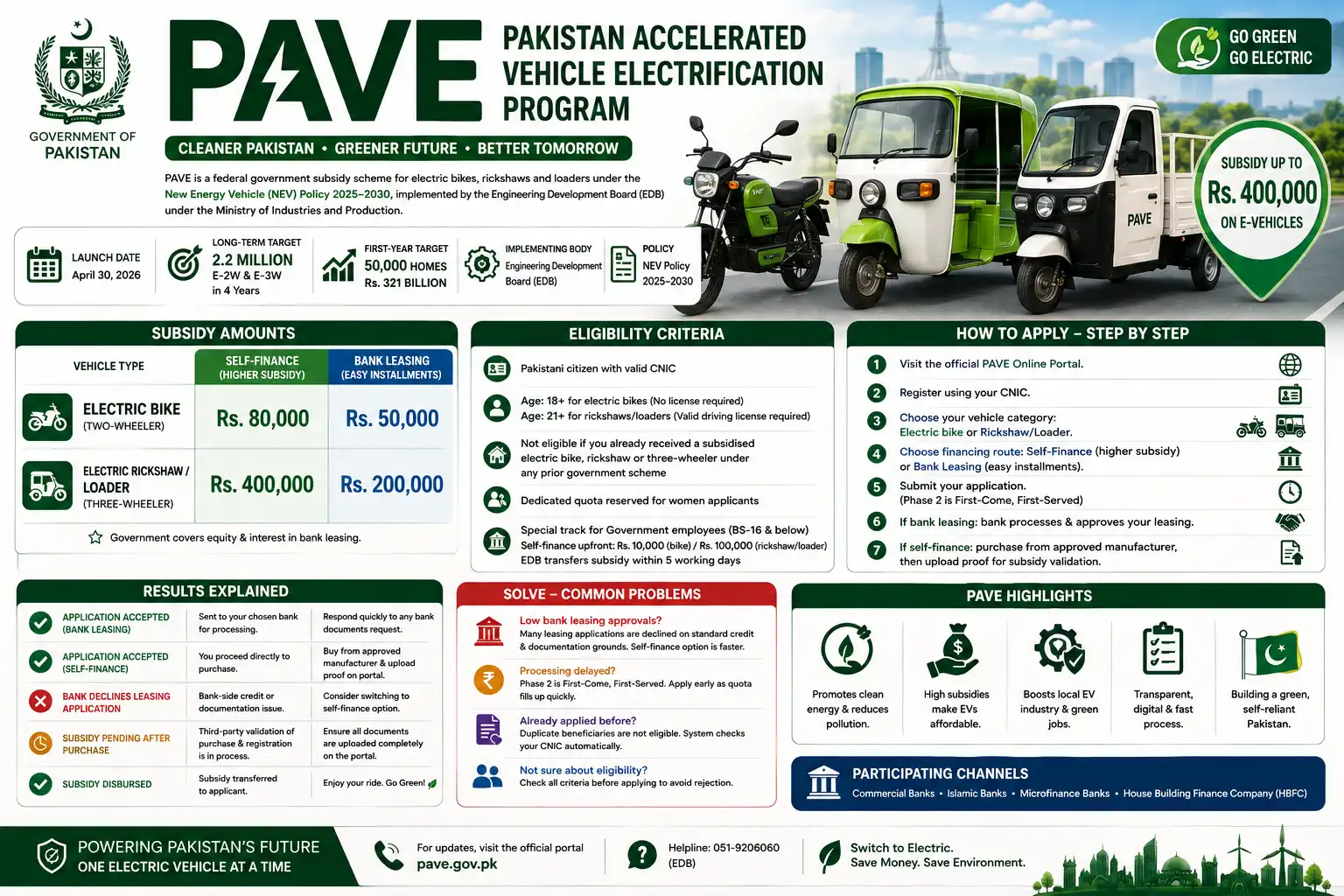
PAVE — the Pakistan Accelerated Vehicle Electrification Program — is the federal government’s subsidy scheme for electric bikes, rickshaws, and loaders, run under the New Energy Vehicle Policy 2025–2030 alongside the other programmes on the Federal Schemes hub. It’s implemented by the Engineering Development Board (EDB) under the Ministry of Industries and Production, offering a direct subsidy of up to Rs. 80,000 on an electric bike and up to Rs. 400,000 on a rickshaw or loader, according to reporting confirmed by The Express Tribune and Business Recorder. Phase 2 moved from computerised balloting to a first-come, first-served model, so how fast you apply now matters more than luck. This guide covers eligibility, subsidy amounts, how to apply, and why some applicants have been getting rejected.
What is PAVE
PAVE distributes electric two- and three-wheelers with a government subsidy attached, either through outright self-finance or through bank leasing with the subsidy applied at purchase. The scheme sits inside a much larger target — the government aims to gradually subsidise 2.2 million electric two- and three-wheelers over four years, with total subsidy spending expected to exceed Rs. 100 billion by 2030, per Express Tribune’s reporting on EDB statements.
| Detail | Figure |
|---|---|
| Implementing body | Engineering Development Board (EDB), Ministry of Industries and Production |
| Policy | New Energy Vehicle (NEV) Policy 2025–2030 |
| Phase 1 target | 41,000 vehicles (40,000 electric bikes, 1,000 rickshaws/loaders) |
| Phase 2 target | More than 78,000 additional vehicles |
| Long-term target | 2.2 million electric two- and three-wheelers over four years |
Subsidy Amounts
| Vehicle Type | Self-Finance Subsidy | Bank-Leasing Subsidy |
|---|---|---|
| Electric bike (two-wheeler) | Rs. 80,000 | Rs. 50,000 |
| Electric rickshaw / loader (three-wheeler) | Rs. 400,000 | Rs. 200,000 |
Choosing self-finance gets you a larger direct subsidy but requires paying the rest of the purchase price upfront; choosing bank leasing spreads the remaining cost into installments, with the federal government covering the equity payment and interest on that leasing arrangement.
Eligibility
| Requirement | Detail |
|---|---|
| Nationality | Pakistani citizen with a valid CNIC |
| Age (electric bikes) | 18 years or older; no driving license required |
| Age (rickshaws/three-wheelers) | 21 years or older; valid driving license required |
| Prior vehicle history | Not eligible if you already received a subsidised electric bike, rickshaw, or three-wheeler under any prior government scheme |
| Women’s quota | A dedicated quota is reserved for women applicants |
Government employees in BS-16 and below serving in federal ministries, attached departments, and subordinate offices have a separate self-finance track — they pay a smaller upfront amount (Rs. 10,000 for a bike, Rs. 100,000 for a rickshaw or loader) directly to the manufacturer, with EDB transferring the applicable subsidy within five working days.
How to Apply — Step by Step
- Go to the official PAVE Online Portal.
- Register using your CNIC.
- Choose your vehicle category — electric bike or rickshaw/loader.
- Choose your financing route: self-finance (larger subsidy, pay balance upfront) or bank leasing (smaller subsidy, installments).
- Submit your application — under Phase 2’s first-come, first-served model, your submission timestamp determines your place in the queue rather than a lucky draw.
- If you selected bank leasing, wait for your chosen bank to process and approve the leasing arrangement.
- If you selected self-finance, purchase the vehicle from an approved manufacturer, then submit proof of purchase and registration on the portal for subsidy validation.
Results Explained
| Outcome | What it means | What to do |
|---|---|---|
| Application accepted, bank-leasing route | Sent to your chosen bank for processing | Respond promptly to any bank documentation request — approval rates for this route have run low |
| Application accepted, self-finance route | You proceed directly to purchase | Buy from an approved manufacturer and submit proof of purchase for subsidy transfer |
| Bank declines leasing application | Bank-side credit or documentation issue, not a PAVE rejection | Consider switching to the self-finance option if you can cover the larger upfront cost |
| Subsidy pending after purchase | Third-party validation of your purchase and registration is still in process | Confirm your documents were fully uploaded to the portal; this step is required before disbursement |
Solve — Common Problems
If you chose the bank-leasing route, be aware that approval rates have run well below target — reporting has shown a large share of leasing applications declined by banks, largely on standard credit and documentation grounds rather than PAVE eligibility itself. If your leasing application stalls, switching to the self-finance track (higher subsidy, but full upfront payment required) has moved much faster for most applicants, based on the same reporting. If you’re a federal government employee in BS-16 or below, use the dedicated self-finance track rather than the general portal — it has a smaller upfront payment and a five-working-day subsidy transfer, separate from the standard process.
In practice, since Phase 2 replaced balloting with first-come, first-served, submitting your application in the opening days of a new allocation round matters far more than it did under the old lottery system — the total vehicle quota is fixed, and the window closes the moment it’s filled rather than on a set calendar date.
FAQs
How much subsidy do I get on an electric bike?
Rs. 80,000 if you self-finance the purchase, or Rs. 50,000 if you go through bank leasing, with the government covering the leasing equity and interest in the latter case.
Do I need a driving license to apply for an electric bike?
No, a driving license is not required for electric bikes, though a valid CNIC is mandatory. Rickshaws and three-wheelers do require a valid driving license.
Can I apply if I already received a subsidised electric vehicle before?
No. Anyone who already received a subsidised electric bike, rickshaw, or three-wheeler under a previous government scheme is not eligible to apply again.
Why did my bank-leasing application get declined?
Bank approval for the leasing route has run low overall, generally on standard credit and documentation grounds rather than a PAVE-specific rejection. Switching to the self-finance option, if affordable, has moved faster for most applicants.
Is there a quota for women applicants?
Yes, a dedicated quota is reserved for women under the scheme.
How is Phase 2 different from Phase 1?
Phase 1 used a computerised e-balloting draw to select applicants. Phase 2 switched to first-come, first-served — your application timestamp now determines your place in the queue instead of a lottery.