
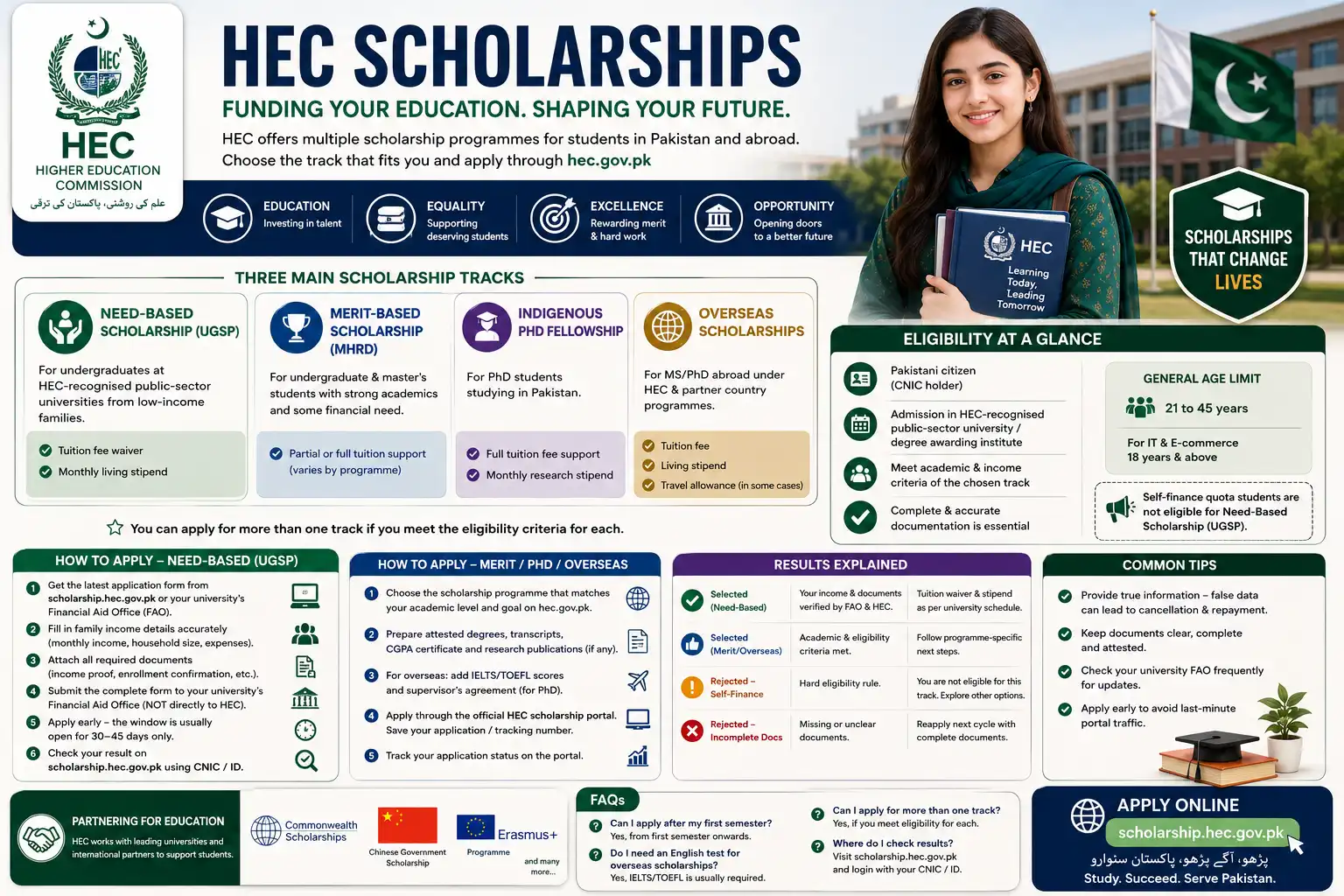
The Higher Education Commission runs several distinct scholarship tracks under one umbrella at hec.gov.pk, separate from the PM Youth Programme’s laptop scheme on this Federal Schemes hub — HEC scholarships fund tuition and living costs, while the laptop scheme provides hardware. The three main tracks are the need-based scholarship for undergraduates at public-sector universities, merit-based programmes for stronger academic profiles, and overseas scholarships for study abroad. Each track has its own eligibility rules, application window, and funding structure, and they aren’t mutually exclusive — a student with both financial need and strong academics can sometimes apply to more than one. This guide explains which track fits which student and how each application actually works.
The Three Scholarship Tracks
| Track | Who it’s for | Funding covers |
|---|---|---|
| Need-Based (UGSP) | Undergraduates at HEC-recognised public-sector universities, admitted on regular (non-self-finance) basis, from low-income families | Tuition fee waiver plus a monthly living stipend |
| Merit-Based / MHRD | Undergraduate and Master’s students combining academic merit with some financial need | Partial or full tuition support, varies by programme |
| Indigenous PhD Fellowship | PhD students studying within Pakistan | Full tuition plus a monthly research stipend |
| Overseas Scholarships | Strong-academic-profile students pursuing MS/PhD abroad, including partner-country programmes (e.g. Chinese Government Scholarship, Commonwealth Scholarships) | Tuition, living stipend abroad, sometimes travel costs |
Eligibility — Which Track Fits You
Need-Based Scholarship (UGSP)
You need to be enrolled at one of the participating public-sector universities — HEC lists roughly a hundred institutions under this programme, including major universities across every province. Admission must be on a regular basis; students admitted through self-finance quotas are explicitly not eligible, and this is treated as a hard rule rather than a case-by-case judgment. Your family’s income documentation is the core of the application — the review committee assesses monthly income, household size, and living circumstances against the programme’s threshold, which HEC updates each cycle.
Merit-Based / MHRD
This track blends academic performance with some degree of financial need, generally requiring a minimum CGPA — commonly cited around 3.0 out of 4.0, though the exact current threshold should be confirmed on hec.gov.pk since requirements are revised periodically. It’s aimed at students who may not qualify for the strictly need-based track but still need meaningful financial support to continue.
Indigenous PhD Fellowship
Open to students pursuing a PhD at a Pakistani institution, this track prioritises research credentials — published papers in HEC-recognised journals meaningfully strengthen an application, alongside a strong academic transcript.
Overseas Scholarships
These cover MS and PhD study abroad through both HEC’s own funding and partner-country programmes. English proficiency test scores (IELTS/TOEFL) are typically required, and for PhD-level overseas applications, having a supervisor’s agreement at the target university in advance is strongly recommended before applying.
How to Apply — Step by Step
Need-Based Scholarship
- Get the current year’s official application form from scholarship.hec.gov.pk or your university’s Financial Aid Office (FAO) — never reuse a form from a previous year, since forms are updated annually.
- Fill in your family’s income details accurately — monthly income, household size, and living expenses. Providing false information can get your scholarship cancelled and require repayment if discovered later.
- Attach every required document — missing even one is enough to get an application rejected. This typically includes income proof and university enrollment confirmation.
- Submit the completed form to your own university’s FAO, not directly to HEC in Islamabad — applications sent straight to HEC’s head office are a common, avoidable mistake.
- Apply in the first week the window opens rather than near the deadline, since application windows typically stay open only 30 to 45 days and late applicants often hit server issues.
- Check your result on scholarship.hec.gov.pk using your CNIC or application ID.
Merit-Based, Indigenous PhD, and Overseas Tracks
- Identify which specific programme matches your academic level and goal on hec.gov.pk’s scholarships section, since HEC runs several named programmes under each broad category.
- Gather your attested degree, complete semester-by-semester transcripts, CGPA certificate, and any published research.
- For overseas applications, add your English proficiency test scores and, for PhD-level applications, a supervisor’s agreement from your target university.
- Submit through the official HEC scholarship portal and save your application/tracking number.
- Track your status on the portal rather than waiting for direct contact, since HEC processes large volumes of applications each cycle.
Results Explained
| Outcome | What it means | What to do |
|---|---|---|
| Selected (need-based) | Your university’s FAO and HEC verified your income documentation | Tuition waiver and stipend disbursement follow your university’s own schedule |
| Rejected — self-finance admission | Hard eligibility rule, not a documentation issue | You’re not eligible for this specific track regardless of financial need; check merit-based options instead |
| Rejected — incomplete documents | A required document was missing or unclear | Reapply next cycle with a complete document set; don’t wait until the final days to submit |
| Selected (merit/overseas) | Academic and, where relevant, English-proficiency criteria were met | Follow your specific programme’s next steps — these vary by scholarship |
Solve — Common Problems
If you’re not sure your application reached HEC, check with your own university’s Financial Aid Office first — need-based applications route through your university, not directly to HEC’s Islamabad office, and a form mailed straight to HEC often goes unanswered. If your application was rejected for an income-documentation issue, ask your FAO exactly which document was missing or unclear before the next cycle opens, since incomplete submissions are one of the most common and most avoidable rejection reasons. If you’re weighing whether to apply for need-based support or a merit-based track, and you’re unsure which fits, applying to both in parallel — rather than waiting to see if you’re admitted to one first — keeps your options open, since deadlines for different tracks don’t always align.
In practice, application windows that open near the start of a semester tend to close faster than students expect, since a large share of applicants wait until the final days and then run into portal traffic or last-minute document problems — applying in the opening week avoids most of that.
FAQs
Can self-finance students apply for the need-based scholarship?
No. Students admitted on a self-finance basis are not eligible for the HEC need-based scholarship — this is a fixed rule regardless of actual financial need. A merit-based track may be worth checking instead.
Where does my need-based application actually go?
To your own university’s Financial Aid Office (FAO), not directly to HEC in Islamabad. Sending your form straight to HEC’s head office is a common mistake that delays or loses applications.
Can I apply for a need-based scholarship after my first semester?
Yes, applications are generally accepted from students already enrolled, from the first semester onwards, though applying at the time of admission is recommended since processing takes time.
What’s the difference between the merit-based and need-based tracks?
The need-based track is primarily income-driven, requiring documented financial need at a participating public university. The merit-based track weighs academic performance more heavily, generally alongside some degree of need, with its own CGPA threshold.
Do overseas scholarships require an English test score?
Yes, typically IELTS or TOEFL scores are required for overseas MS and PhD applications, alongside academic transcripts and, for PhD-level applications, a supervisor’s agreement at the target university.
If I provide false income information, what happens?
If false information is later discovered, the scholarship can be cancelled and you may be required to repay everything already received — HEC treats this as a serious compliance issue, not a minor error.