
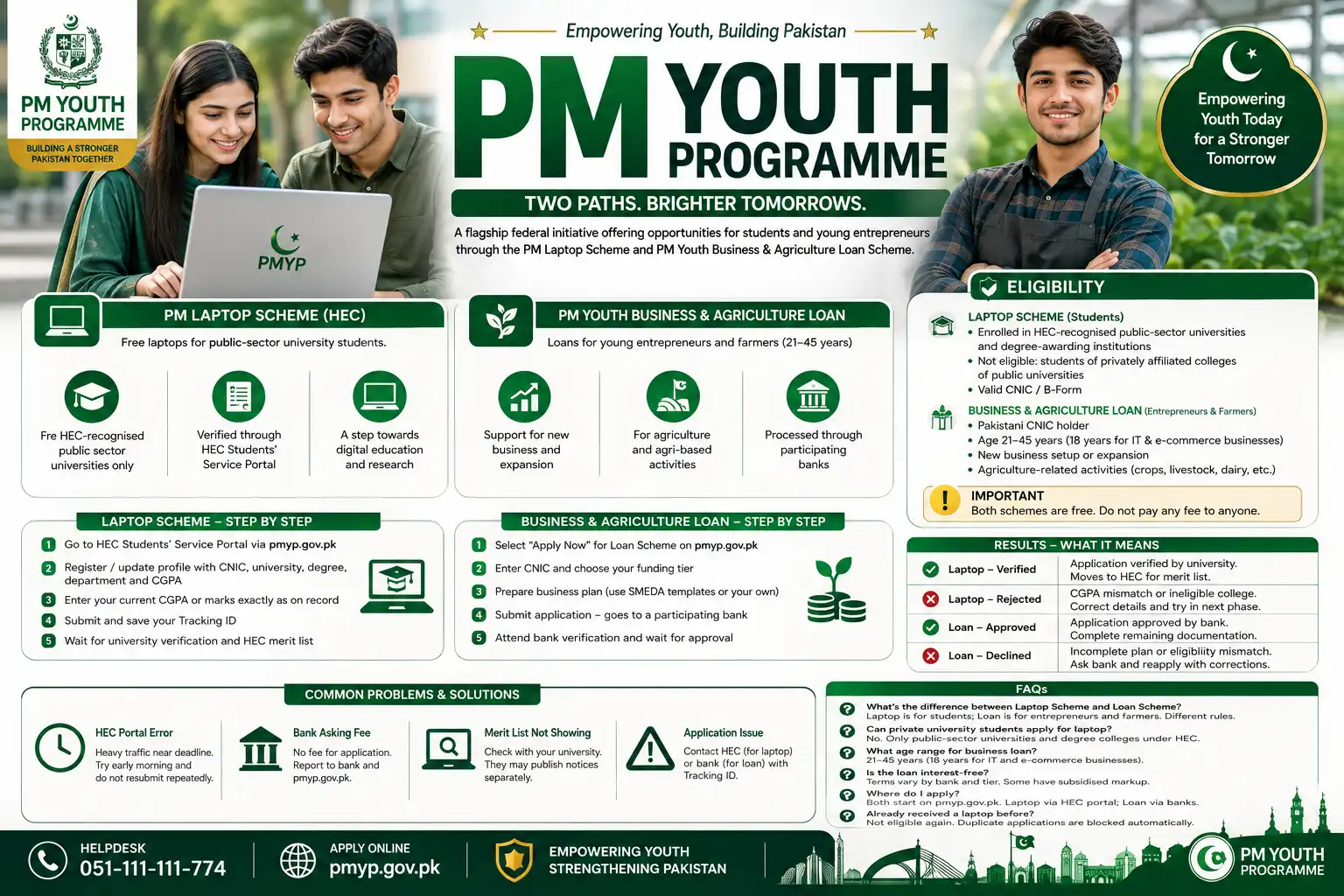
The PM Youth Programme is the federal government’s main initiative for young Pakistanis, run through pmyp.gov.pk and split into two distinct tracks: a free laptop scheme for university students and a business/agriculture loan scheme for young entrepreneurs. It sits alongside BISP as one of the two largest programmes on this Federal Schemes hub, but serves a completely different audience — students and young business owners rather than low-income households. The laptop track is run in coordination with the Higher Education Commission (HEC), while the loan track is delivered through a panel of participating banks. This guide routes you to the right track and explains how eligibility works for each.
What is the PM Youth Programme
The PM Youth Programme groups two separate schemes under one umbrella so applicants only need to learn one portal system. Both tracks share the same CNIC-based online application model through pmyp.gov.pk, but each has its own eligibility rules, documents, and processing bank or department.
| Track | Who it’s for | Managed with |
|---|---|---|
| PM Laptop Scheme | HEC-verified public-sector university students | Higher Education Commission (HEC) |
| PM Youth Business & Agriculture Loan | Entrepreneurs and farmers aged roughly 21–45 | Panel of commercial, Islamic, and SME banks |
Eligibility — Which Track Fits You
Laptop Scheme Eligibility
Only students enrolled in HEC-recognised public-sector universities and degree-awarding institutions qualify. Students at privately affiliated colleges of public universities are explicitly not eligible under current HEC rules, and applications from that category are rejected automatically.
Business & Agriculture Loan Eligibility
Applicants generally need to be Pakistani CNIC holders aged 21 to 45, with the age floor dropping to 18 for IT and e-commerce ventures. The scheme covers both new business setup and expansion, plus agriculture-sector activity such as crops, livestock, and dairy, delivered through designated partner banks rather than a direct government payout.
How to Apply
Laptop Scheme — Step by Step
- Go to the HEC Students’ Service Portal linked from pmyp.gov.pk.
- Register or update your profile with CNIC/B-Form, university, department, and degree level.
- Enter your current CGPA or marks exactly as recorded by your university — even a small mismatch causes rejection.
- Submit the form and save your tracking ID.
- Wait for your university to verify your application before it moves to HEC for merit-list processing.
Full step-by-step detail, phase dates, and merit-list checking are covered in the dedicated PM Laptop Scheme guide.
Business & Agriculture Loan — Step by Step
- Open the PM Youth Programme portal and select “Apply Now” for the loan scheme.
- Enter your CNIC number and choose your funding tier based on how much capital you need.
- Prepare a business plan — SMEDA-provided pre-feasibility templates can be used, or you can submit your own project.
- Submit your application; it routes to a participating bank for review.
- Attend any bank-requested verification before disbursement.
Full step-by-step detail, loan tiers, and bank list are covered in the dedicated PM Youth Business & Agriculture Loan guide.
Results Explained
| Outcome | What it means | What to do |
|---|---|---|
| Laptop application verified by university | Moves to HEC for the merit list | Watch your university’s notice board and the HEC portal for the merit-list date |
| Laptop application rejected | Usually a CGPA mismatch or ineligible college type | Correct the detail with your university before the deadline, or check the next phase |
| Loan application approved by bank | Moves to disbursement stage | Complete any remaining documentation the bank requests |
| Loan application declined | Usually incomplete business plan or eligibility mismatch | Ask the bank for the specific reason and reapply with a corrected plan |
Solve — Common Problems
If the HEC portal shows an error near a deadline, it’s usually heavy traffic rather than a problem with your application — try again early the next morning rather than repeatedly resubmitting. If a bank branch asks for a fee to “process” your loan application faster, that’s not part of the official scheme; report it to the bank’s own complaint channel and to pmyp.gov.pk directly. If your laptop merit-list result doesn’t appear, check with your university first, since some universities publish separate notices alongside the central HEC list.
In practice, both the HEC laptop portal and bank loan queues slow down sharply in the final days of any phase — applying in the opening week rather than waiting for the deadline avoids most of the frustration applicants report.
FAQs
What’s the difference between the PM Laptop Scheme and the PM Youth Business Loan?
The laptop scheme gives free laptops to eligible public-sector university students, while the business loan gives financing to young entrepreneurs and farmers. They’re run under the same PM Youth Programme umbrella but have completely separate eligibility rules and application processes.
Can a private university student apply for the laptop scheme?
No. Only students at HEC-recognised public-sector universities and degree colleges qualify, and privately affiliated colleges of public universities are explicitly excluded.
What age range applies to the business loan scheme?
Applicants are generally required to be 21 to 45 years old, with an 18-year minimum specifically for IT and e-commerce businesses.
Is the business loan interest-free?
Terms vary by tier and bank; some tiers carry a subsidised low markup rather than being fully interest-free. Confirm the exact rate for your tier directly with the participating bank at application time, since terms are periodically revised.
Where do I apply for either scheme?
Both start through pmyp.gov.pk — the laptop scheme routes to the HEC Students’ Service Portal, and the loan scheme routes to a participating bank for processing.
What if I already received a laptop in a previous phase?
You’re not eligible again — the portal checks your CNIC/B-Form against previous phases and blocks duplicate applications automatically.